
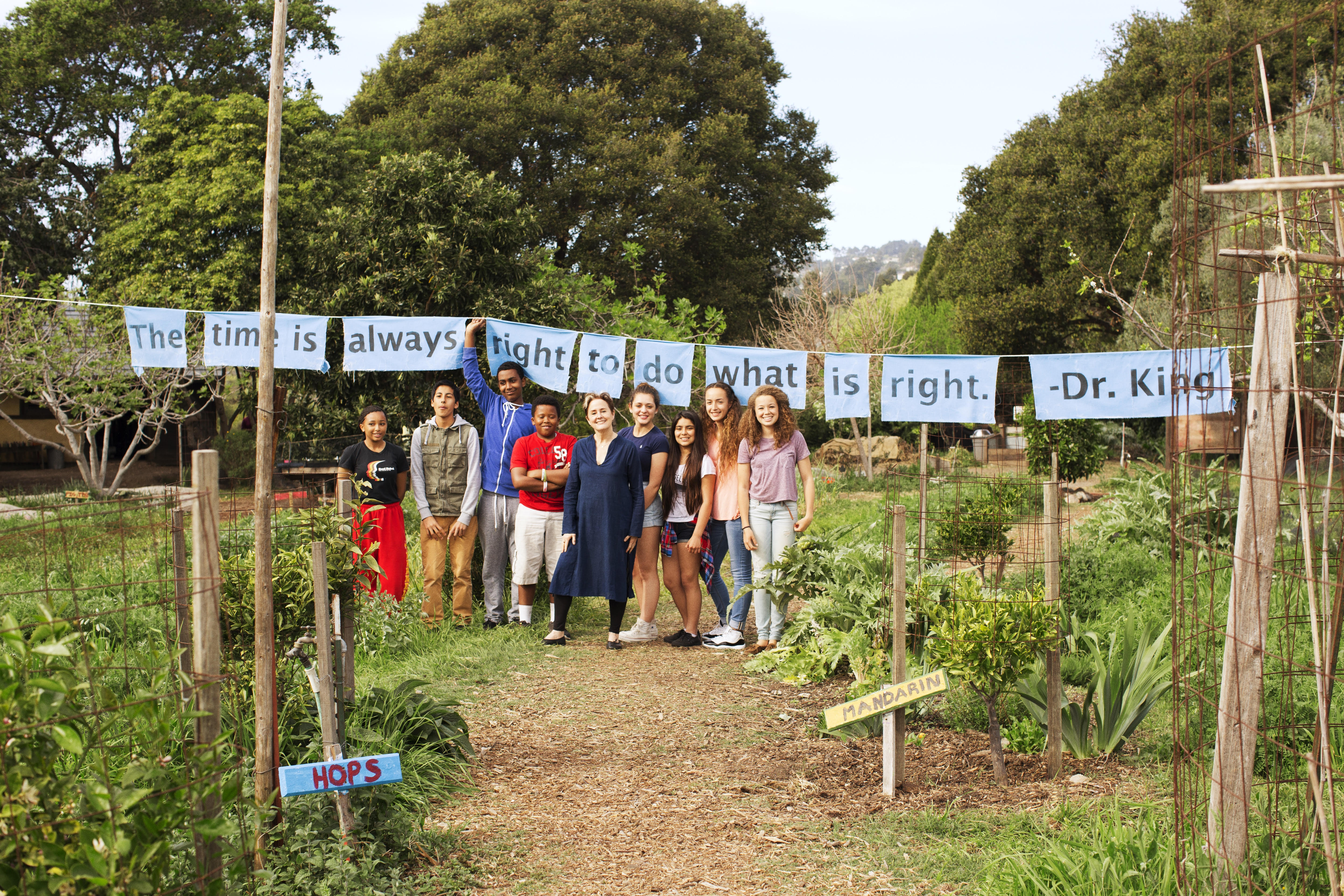
The Original Edible Schoolyard at Martin Luther King Jr. Middle School in Berkeley, California Recognizing the potential of the idea, Zenobia Barlow and the Center for Ecoliteracy provided funding for ESY’s first full-time garden director, David Hawkins. Within two years, more than an acre of asphalt was cleared, a cover crop was planted and David and his first group of students spent the summer in the garden ‘building the bones.’
In the fall of our third year, the kitchen became a reality. We hired our kitchen director, a chef named Esther Cook, who continues to teach at ESY to this day. Teachers, parents and community members came together to clear away garbage and cobwebs and the abandoned school cafeteria became the kitchen classroom.
Many of the school’s teachers, increasingly comfortable with hands-on learning, collaborated with David and Esther to generate garden and kitchen lessons linked to classroom studies. The Center for Ecoliteracy supported science and math teacher Jay Cohen to write lessons, and teacher Akemi Hamai to liaise with the school. Classroom teachers began scheduling regular class time with their students in the garden and kitchen.
By year five, ESY taught ten, ninety-minute classes a week in both the garden and kitchen. We hired Marsha Guerrero to oversee the program and our staff grew to eight. English teacher Josie Gerst made it possible for us to host traditional school celebrations such as Family Writing Night and the English Language Learners Dinner, expanding our relationship with the broader school community.
As the garden grew so did the program. Students cleared trees and brush to place two 3,500-gallon cisterns that collect the rainwater that irrigates our lower orchard. We built a chicken coop for our expanding flock of chickens and ducks, and this past year, students used more than 500 eggs in the kitchen classroom. Our annual Mother’s Day Plant Sale has become a significant community and fundraising event. In addition to our summer program for students, the Edible Schoolyard hosts a teaching academy for educators from around the United States and the world, who want to begin or further develop, edible education programs in their communities.
Over the past sixteen years, the Edible Schoolyard has not only become an integral part of life at King School, but also an important teaching institution and model of edible education, that has inspired national and international programs. Each year, the Edible Schoolyard hosts over 1,000 visitors who experience its impact for themselves. Guests have included HRH Prince of Wales, Governor of California Jerry Brown, multiple state Senators, California’s Secretary of Agriculture and the Surgeon-General. For the 2005 Smithsonian Folklife Festival, we brought the Edible Schoolyard to the National Mall in Washington DC. The site was visited by one million people.
Today, the Edible Schoolyard is lush with more than one hundred varieties of seasonal vegetables, herbs, vines, berries, flowers and fruit trees. Our staff includes five teachers, two AmeriCorps members, and two adminstrative positions – fully supported by The Edible Schoolyard Project. A robust corps of thirty volunteers generously supports our work. We have served over 7,000 students, who often return to tell us that what they remember most about middle school is the time they spent in the Edible Schoolyard.
Chez Panisse Foundation
School Lunch Initiative
The fully realized vision of edible education has always been to mirror the lessons of the kitchen and garden classroom at the Edible Schoolyard with real food served in the lunchroom. In 2003, the Chez Panisse Foundation partnered with the Berkeley Unified School District and the Center for Eco-literacy to implement a model for this vision. After three years of on-the-ground work, this collaboration transformed what 10,000 Berkeley public school children are offered for breakfast and lunch in school and how they learn about food, every day.
The new Dining Commons at King Middle School now serves as the central kitchen for all 16 schools in the district, providing 10,000 meals per day, made with wholesome, fresh, and mostly organic ingredients. Designed to engage students, the Dining Commons features on-site composting, recycling stations and real tableware. The Dining Commons presents myriad opportunities to connect garden, kitchen, classroom, and lunchroom experiences.
In 2010, the Center for Weight and Health at UC Berkeley released an evaluation report of the School Lunch Initiative and its impact on children’s attitudes, behavior and knowledge towards food. The results confirmed our anecdotal experience that indeed when children are engaged in the growing, harvesting and preparing of food they are far more likely to eat it. The School Lunch Initiative is recognized nationally as an innovative and effective food service program that continues to inspire reform.
Founding Edible Schooolyards
Today in addition to supporting the Edible Schoolyard Berkeley and the Founding Edible Schoolyards, we are expanding our initiatives online to build and share a national food curriculum. This online program will allow educational garden, kitchen, and lunch programs around the world to network, share their lessons and best practices, and gain a collective voice for change.